
Gas distribution in bulk grain fumigation is where most on-farm fumigation programs fall short. Sealing up the shed and introducing the fumigant is the straightforward part. Where that gas actually goes once it is in the grain mass is the question that determines whether your fumigation is working.
In any bulk grain storage without active recirculation, the honest answer is that you cannot be entirely sure. And that uncertainty is not a minor detail. It is the difference between a fumigation that works and one that quietly contributes to phosphine resistance in your grain stack.
How phosphine moves through a grain shed
Phosphine gas is heavier than air. In a passively treated space, it tends to concentrate near the source and at lower points in the stack. In a tall silo, this stratification effect is well documented. In a flat bulk grain shed, the challenge is different but related: gas concentration can be high near the fumigation point and fall away significantly toward the edges, the far end of the shed and particularly at floor level.
Research on gas distribution in bulk grain fumigation has consistently identified this as one of the hardest problems to solve. Without active movement, the gas relies on diffusion through the grain mass, which is slow, uneven and affected by grain type, moisture content, temperature and the depth of the stack.
In practice, this means some parts of your grain receive a lethal phosphine dose. Others receive a sub-lethal one.
Why sub-lethal phosphine doses matter
Phosphine resistance is increasing in Australian stored grain insects. It has been present in the industry for years and it is getting stronger.
The Strategy to Manage Insect Resistance to Grain Protection Chemicals, published by Grain Trade Australia, identifies uneven application as a key driver of resistance development. You can read the full strategy here. When insects are exposed to fumigant at concentrations below the lethal threshold, some survive. Those that survive are the ones most likely to carry resistance traits. Each generation that passes through a sub-lethal dose makes the problem worse.
This is why hitting and holding concentration levels consistently across the entire grain mass is not just about efficacy today. It is about protecting the chemistry for the future.
What effective grain fumigation actually requires
Two concentration thresholds are commonly referenced across the industry as targets for effective phosphine fumigation:
- 200 PPM maintained for 10 days, commonly cited for susceptible insect populations at all life stages.
- 550 PPM maintained for 7 days, commonly referenced for addressing most phosphine-resistant insect strains.
These figures are not universally agreed upon. The right target will depend on your resistance history, grain type and the advice of your fumigation contractor. But the principle is clear: you need to reach threshold concentration across the whole grain mass, not just near the point of introduction, and hold it for the required period.
In any passively fumigated storage, you cannot verify that is happening in every part of the stack without extensive probing. And even then, you can only read what the probes tell you after the fact.
What recirculation changes in phosphine gas distribution
Active recirculation moves phosphine through the grain mass from the point of introduction, rather than relying on diffusion. Gas is pushed through the stack, not left to find its own way.
The difference shows up most clearly at floor level and at distance from the fumigation source. These are exactly the zones where passive fumigation tends to fall short.
In the FumoFlow trial conducted in March 2026 on 5,420 tonnes of wheat, 12 probes were placed throughout the grain stack at both surface and floor level. Every probe exceeded 550 PPM within 49 hours and held above it for the full 7-day period. Every probe also held above 200 PPM for the full 10 days, including those at floor level and furthest from the fumigation boxes. The full trial results are available here.
The ventilation side of the fumigation problem
Getting gas in is only half the equation. Getting it out safely matters just as much.
Phosphine Workplace Exposure Limits are changing from 1 December 2026. The 8-hour time-weighted average will reduce from 0.3 ppm to 0.05 ppm, and the existing STEL of 1 ppm will be replaced with a Peak Limit of 0.15 ppm. These changes have been confirmed by Safe Work Australia and Grain Trade Australia. For a plain English breakdown of what the new limits mean for your operation, see our article here.
Note: Victoria has not yet officially signed off on the change. WorkSafe Victoria is currently undertaking a Regulatory Impact Statement to assess the impacts. Growers in Victoria should monitor this closely.
Passive ventilation is slow regardless of storage type. Whether you are opening up a silo or removing a tarp, the process depends on natural air movement and gives operators limited control over how quickly concentrations drop to safe levels.
A system with powered ventilation can clear a storage faster, from outside, with no requirement for early re-entry. In the FumoFlow trial on a bulk grain shed, safe clearance levels were reached within 4 days after fumigation was complete.
What this means for your grain storage operation
If you are storing high-grade grain on-farm and fumigating with phosphine, the system you use directly affects whether that fumigation is working the way you think it is.
A storage that looks sealed is not the same as a storage where you can verify gas distribution in bulk grain fumigation. And an insect count of zero after fumigation is not always proof that the fumigation was effective. Resistance can develop quietly, showing up only when the problem is already established.
Understanding the distribution problem is the first step. The second is making sure the system you use addresses it.
Find out more about FumoFlow
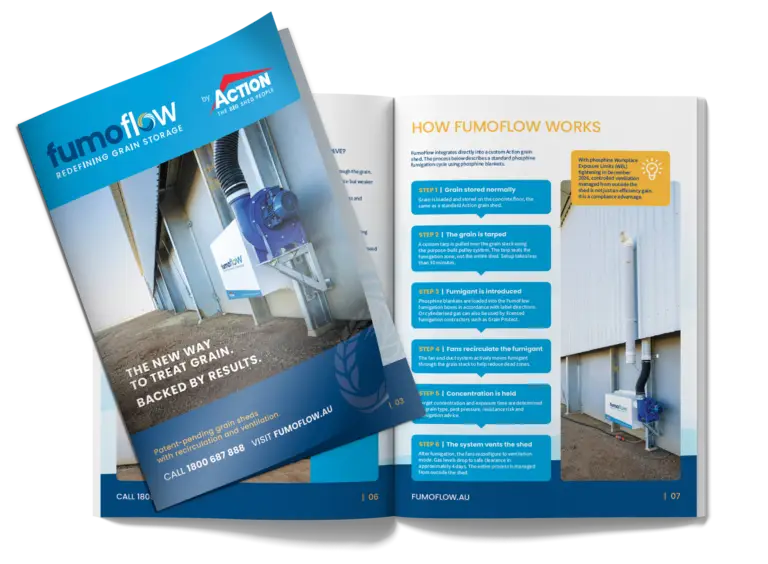
FumoFlow is an integrated fumigation system built into Action Steel grain sheds, designed to deliver consistent phosphine gas distribution across the full grain mass. To find out more or to talk through your grain storage setup get in touch with us here or call 1800 68 78 88.