Phosphine use and exposure regulations exist to protect the Australian grain industry and keep the people in the industry safe.
These regulations have never been more important as the risk of insect resistance increases, growers look for new market opportunities, and occupational health evidence shows adverse effects may occur at lower concentrations than previously thought.
Phosphine exposure regulations apply to all grain growers treating grain in some capacity.
And it pays to keep up to date with the impending changes.
What are the new phosphine exposure regulations? When do they take effect? And what does that mean for you?
In this article, we cover:
Please note that information provided in this article is general only and does not constitute professional advice. Consult with the relevant industry body for the latest information and advice on how this applies to your operation.
Let’s get into it!
Safe Work Australia exposure limits are being tightened.
Australia is moving from the current Workplace Exposure Standards (WES) to Workplace Exposure Limits (WEL) for airborne contaminants.
This includes stricter allowable exposure limits for phosphine gas.
Under the updated framework, the time-weighted average (TWA) limit for phosphine is being reduced significantly, and a new short-term peak limit is being introduced.
Firstly, the TWA allowable airborne exposure limit is being lowered to 0.05ppm (parts per million).
This replaces the existing standard of 0.3ppm TWA.
Secondly, a new short-term standard (STEL) peak limit of 0.15ppm is being introduced.
This replaces the existing standard of 1ppm STEL.
The updated “limits” terminology reinforces that these are enforceable limits rather than simply advisable levels.
Growers and contractors will need to ensure their fumigation process meets these tighter limits before staff re-enter storages, or before grain is handled or delivered.
The new phosphine exposure limits are in response to toxicology studies showing pulmonary and neurological effects in workers, at lower levels than previously thought.
The new levels have been shaped by international assessments such as American Conference of Governmental Industrial Hygienists (ACGIH) and various EU committees, including the European Chemicals Agency (ECHA)
Workplace safety aside, it was also considered timely to modernise outdated standards. The previous WES list dated back decades.
The updated WEL also supports a broader industry focus on eliminating fumigation misuse and mitigating the risk of insect resistance.
The primary driver for the phosphine exposure limit change is workplace health evidence, not insect resistance data per se.
However, it is widely recognised that more stringent fumigation practices such as gas-tight storage and uniform gas distribution are required to reduce the risk of phosphine resistance.
The new phosphine exposure limits were planned to take effect on the 1st of December 2026.
However, Victoria has deferred the changes until December 2029, with workplaces and growers continuing to comply with the existing standards.
Other states have not yet announced a deferral and so from 1st of December 2026 onwards, the updated Workplace Exposure Limits (WEL) become the enforceable exposure limits for airborne contaminants, including phosphine.
The new limits will change how growers and contractors plan, execute and vent fumigated storage.
Growers will need to ensure fumigated storages reach far lower residual gas levels before staff can enter, or grain can be handled and delivered.
Passive venting does not reliably achieve these limits, so controlled venting, and disciplined monitoring and record keeping, become more important.
Review your grain storage and fumigation processes to comply with the new limits and to reduce the risk of loads being rejected at receival sites.
This could include:
These additional steps will take time and may require new equipment or training.
It is worth keeping in mind the increased risk of receival sites rejecting grain – particularly as there are inconsistent testing methods between sites. For example, spear versus headspace or surface sampling may return different results.
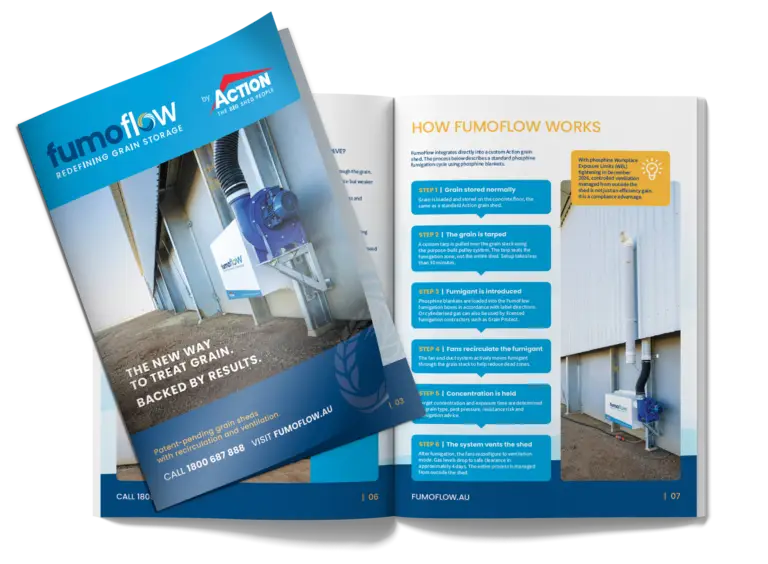
FumoFlow grain sheds include a patent-pending recirculation and ventilation system that shortens both the time needed to reach required concentration levels, and the time needed to reach allowable exposure limits, post fumigation.
This benefit alone makes a FumoFlow grain shed a smart and forward-thinking investment for expanding cropping operations.
Here’s why:
Looking to upgrade your grain storage to comply with new phosphine exposure regulations?
Talk to the team at Action to learn how a FumoFlow grain shed could work in your storage mix, and help you reach the new exposure limits faster, post fumigation.
Call 1800 687 888 or book a project consultation via the Enquire Now button.