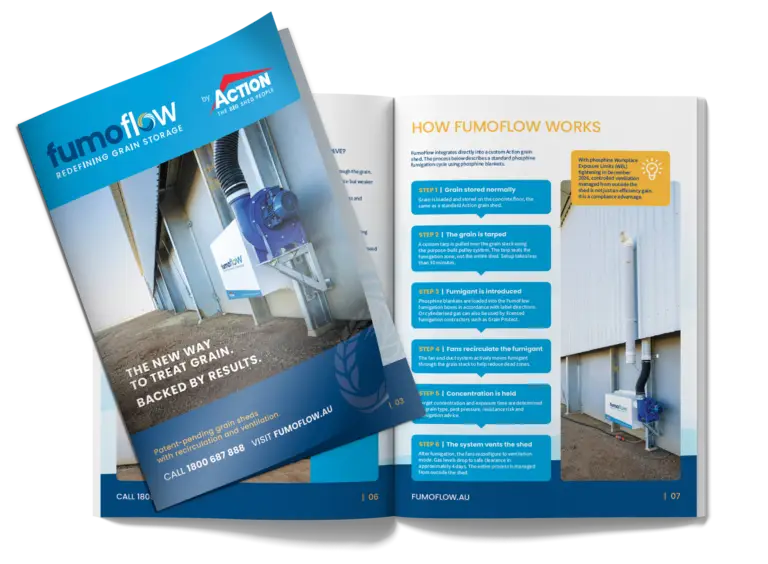

In March 2026, Action Steel ran a full-scale phosphine fumigation grain shed trial using FumoFlow technology. 5,420 tonnes of wheat. 15 days of data.
Here is what we found.
The Trial Setup
The trial began on 24 March 2026, on a FumoFlow grain shed storing 5,420 tonnes of wheat. The fumigation used phosphine blankets introduced via the FumoFlow fumigation boxes at maximum label rate.
12 Probes were placed throughout the entire grain stack, giving us the ability to monitor phosphine concentration and distribution from introduction through to ventilation.
Commonly Referenced Industry Thresholds
When it comes to phosphine fumigation, two concentration thresholds are commonly referenced across the industry as targets for effective pest control:
200 PPM maintained for 10 days is commonly cited for overcoming susceptible insect populations at all life stages.
550 PPM maintained for 7 days is commonly referenced for addressing most phosphine-resistant insect strains.
It is worth noting these figures are still being researched, and the right target for your operation will depend on your phosphine resistance history, grain type, and advice from your fumigation contractor. The higher the resistance concern, the more important it becomes to hit and hold concentration levels consistently.
The Results
49 hours after introduction, the average phosphine concentration was over 1000PPM, and due to the rapid distribution and recirculation of fumigant through the grain, by 76 hours, all probes were above 700PPM.
Every probe exceeded 550 PPM within that same window and held above it for the full 7-day period, and above 200 PPM for the full 10-day period.
Not one probe dropped below either threshold during the required exposure window.
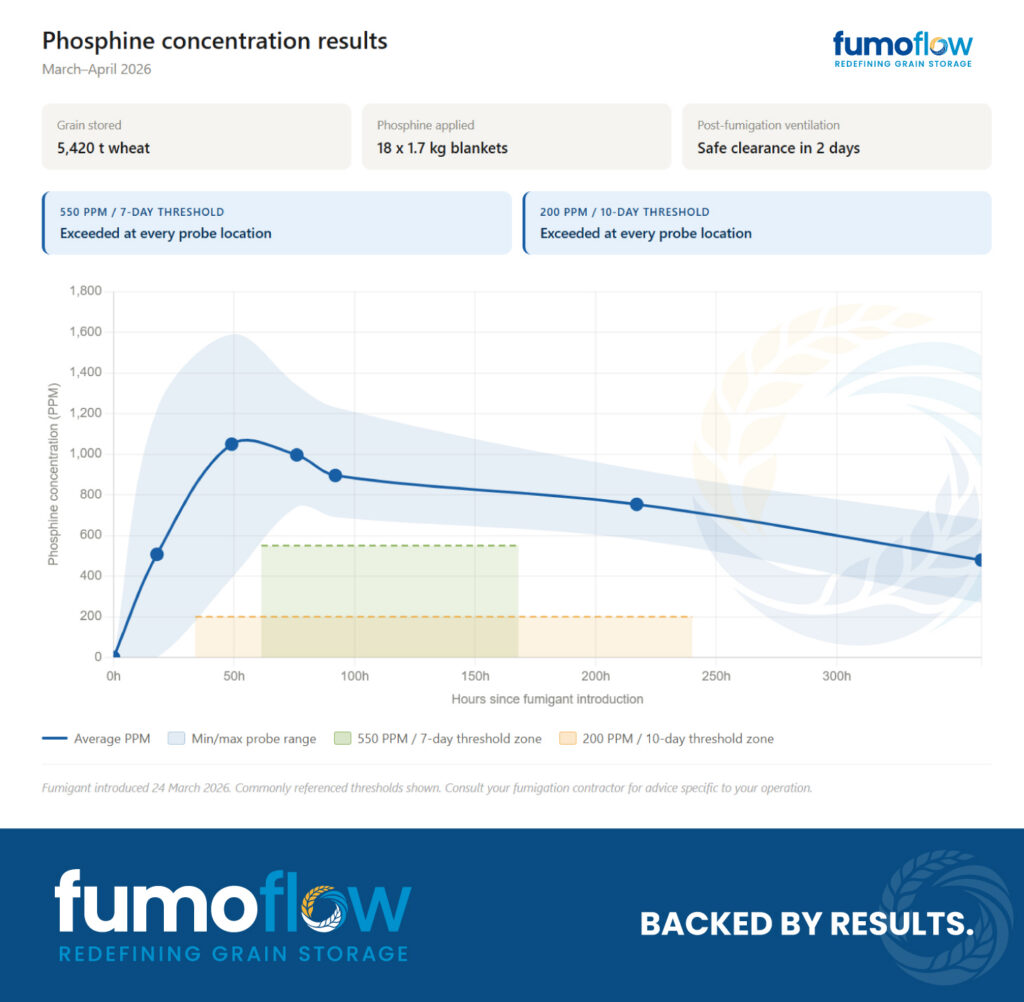
The results confirm what the FumoFlow system is designed to deliver: consistent, proven phosphine concentration levels across the full grain stack, not just near the point of introduction.
Gas Distribution: The Critical Difference
In traditional grain fumigation, achieving uniform gas distribution is one of the hardest problems to solve, and getting it wrong is a recipe for developing phosphine resistance in grain pests. In a non-recirculating silo or shed, phosphine distribution can never be guaranteed. Concentrations near the fumigant source can be high while readings further away, particularly at floor level, fall short.
FumoFlow’s recirculation system actively moves gas through the grain mass from the point of introduction. The trial results reflect this: probes at floor level and at distance from the fumigation boxes returned concentrations well above threshold, consistent with probes closer to the source.
This is not a theoretical benefit. The data shows it.
Post-Fumigation Ventilation
Once the fumigation period was complete, the FumoFlow fans were reconfigured for ventilation mode. The shed reached safe clearance levels in 4 days, allowing staff re-entry and grain handling to resume quickly.
Traditional sealed shed fumigation typically relies on passive ventilation after the tarp is removed, which takes considerably longer and requires manual re-entry to start the process. With FumoFlow, the entire ventilation cycle is managed from outside the shed, reducing operator exposure at every stage.
With tighter phosphine Workplace Exposure Limits (WEL) coming into effect in December 2026, faster and controlled ventilation is not just an efficiency gain. It is a compliance advantage.
What This Means for Grain Growers
This was not just a lab test. It was a commercial scale fumigation trial, on a real grain shed, with 5420 tons of grain.
The trial showed that FumoFlow can deliver:
- Consistent phosphine distribution across the full grain stack, surface to floor
- Concentration levels that exceed current recommended fumigation concentrations
- Faster, safer ventilation after fumigation is complete
- A repeatable, controllable process that reduces operator risk
If you are storing grain on-farm and fumigating with phosphine, the system you use matters more than ever. Resistance pressure is increasing. Regulatory requirements are tightening. And the cost of a failed fumigation, whether that is rejected grain at receival or a reinfestation, is real.
FumoFlow is the only purpose-built grain shed fumigation system with patent-pending recirculation and ventilation designed to address all of this.
Beyond fumigation, a FumoFlow grain shed delivers all the operational advantages of purpose-built bulk grain storage. Truck tipping inside, multi-use capability, full grain segregation, and the ability to harvest at elevated moisture. Read more about the full benefits of a FumoFlow grain shed here.
We knew grain growers needed a better way to fumigate bulk grain sheds. It took testing, setbacks, and plenty of learning, but the results now show what is possible. FumoFlow is just getting started.
The results back it up.
FumoFlow is a product of Action Steel.
Keen to learn more about FumoFlow?