
An 18-month development, built with growers and contractors
FumoFlow didn’t start on a drawing board. It started in conversations with growers and fumigation contractors about where fumigation was falling short and what a better system would need to do.
Over 18 months, that feedback shaped a grain shed with recirculation and ventilation technology designed into the structure itself. Not something bolted on after the shed goes up. A system engineered to move fumigant actively through the full grain mass from the point it’s introduced, aiming to keep concentration more consistent throughout the stack rather than just near the point of introduction.
The result is a patent-pending grain shed, first-of-its-kind in the Australian market.
A FumoFlow fumigation looks different to a standard one from the moment you start. Not because the chemistry changes, but because the system built into the shed takes over the parts that are usually left to chance.
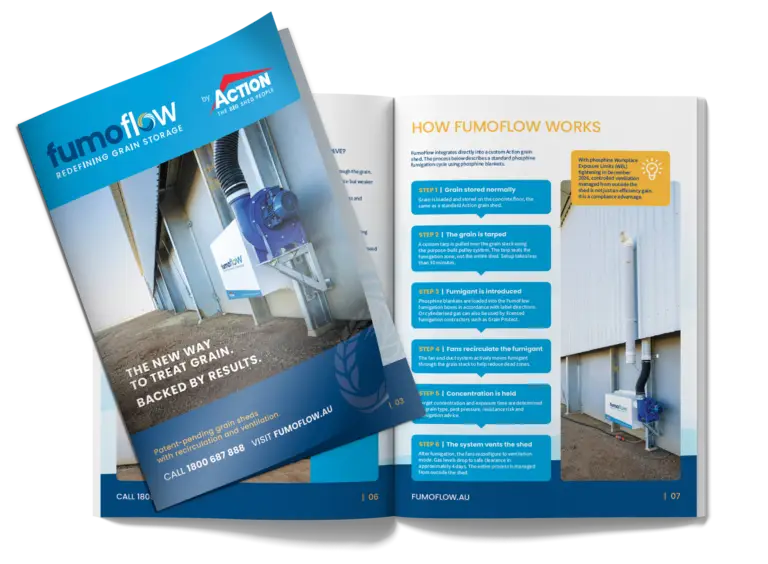
Here’s how FumoFlow works, from sealing the shed through to safe re-entry.
Before fumigation: loading and sealing
Grain goes into a FumoFlow shed the same way it would in any Action grain shed, loaded and stacked on the concrete floor.
A custom fumigation tarp is pulled across the top of the grain stack using a pulley system, then sealed to custom flashings built into the top of the wall panels. The introduction points for fumigant are already built into the shed as well, so there is no separate step to fit equipment on the day.
During fumigation: active recirculation
Fumigant is released through the shed’s designated entry points, using whatever method is already in use in your operation, blankets, tablets, or cylinderised gas through a licensed contractor.
From there, recirculation takes over. Fumigant is introduced over the top of the grain, under the tarp, and drawn down through the stack, exiting through vents in the lower part of the wall panels. Fans then push it back up and around again, keeping the gas moving through the full grain mass rather than settling in one place. As a result, fumigant is distributed through the grain bulk quickly and evenly, reaching required concentration levels faster and more consistently across the stack, helping avoid dead zones.
Once that concentration is reached across the stack, the fans switch off and the grain is held for the required exposure period.
The reasoning behind why this matters for gas distribution is covered in detail in our article on gas distribution in bulk grain fumigation, worth a read if you want the full picture.
After fumigation: controlled ventilation
Once the hold period is complete, the same fan system switches to venting, clearing residual gas from the shed and managed from outside. There is no need to open up the shed and start the process manually the way you would with traditional shed fumigation.
For growers and staff, this means a clearer, more predictable point at which it is safe to go back in and resume handling.
As phosphine Workplace Exposure Limits tighten, faster and controlled ventilation isn’t just a convenience. It’s becoming part of doing the job compliantly. Safe Work Australia has documented a breakdown of the newly proposed phosphine exposure limits here.
How FumoFlow works in the field: trial data
This is how the system is designed to work. We have also tested it under real, commercial-scale conditions, and the results are published in full. If you want the numbers behind the process, our first full-scale trial results are worth a look.
Talk to us about FumoFlow
FumoFlow is a grain shed system built around one goal, getting fumigant where it needs to go and clearing it out safely once the job is done. That’s how FumoFlow works.
To find out more about how FumoFlow could work on your operation, get in touch via our contact page, or give our building consultants a call on 1800 68 78 88, to walk you through the process.