
The new phosphine exposure limits have been one of the biggest talking points in grain storage this year. In August, Victoria changed the timeline, and other states are still working through their position.
Here’s an update on where things stand heading into harvest.
What’s changed: Victoria has until 2029
In August 2026, WorkSafe Victoria announced it would delay the new workplace exposure limits (WELs) for 15 airborne contaminants, including phosphine. They were due to start on 1 December 2026. In Victoria they now start on 1 December 2029.
The grain industry has been raising concerns for some time that the new phosphine limits can’t yet be reliably measured or met in practice, particularly the short-term peak limit. Grain Trade Australia (GTA) welcomed the decision as a practical step.
“A standard that cannot be measured cannot be verified, cannot be enforced consistently, and cannot demonstrably improve safety outcomes,” said GTA CEO Pat O’Shannassy.
Phosphine is the main fumigant protecting stored grain from insect pests, from on-farm storage right through to bulk terminals, and there is no registered, commercially viable alternative at the scale the industry needs. GTA says the extra time allows for validating measurement methods, understanding the operational and economic impacts, and developing controls that growers and the wider industry can actually put in place.
For Victorian growers, the current standard stays in place for this harvest and the next few.
What about the other states?
Outside Victoria, the new limits are still scheduled to start on 1 December 2026. No other state has announced a delay yet, but the conversation is still very much open.
Industry groups right across the country, including GTA and state farming bodies, are working with governments on a practical way forward. South Australia has said it’s considering a deferral, and Queensland is consulting with industry.
We’ll keep this article updated as states make announcements. In the meantime, the simple steps below will put you in a good position, whatever the outcome.
The numbers
The new limits apply to how much phosphine a person can be exposed to in the air at work. On farm, that means you, your family, staff and contractors working around fumigated grain.
| Current standard | New limit | |
| 8-hour average (TWA) | 0.3 ppm | 0.05 ppm |
| Short-term / peak | 1 ppm | 0.15 ppm |
That’s around a sixth of the current 8-hour limit. Safe Work Australia says the change reflects current scientific evidence on the health effects of phosphine exposure.
What it means for your grain this harvest
Phosphine is still available and still the go-to fumigant for most stored grain in Australia. What changes is how carefully storage has to be vented and checked before anyone opens it up or handles the grain.
If you’re in Victoria, you have time to plan. The limits are coming, just later, so the next few seasons are a good window to review how you fumigate, vent and test.
If you’re outside Victoria, there’s still around two months before 1 December. That’s enough time to get a simple plan in place, and a few practical steps will set you up well:
- Talk to your fumigation contractor or agronomist. Ask how they’re adapting their venting and testing for the new limits, and what they’ll need from you.
- Check your gas meter. Many meters used on farm aren’t designed to read accurately down to the new levels. Ask your supplier what they recommend.
- Have a chat with your grain buyer or receival site. Find out what clearance testing they’ll want before delivery, so there are no surprises at the weighbridge.
- Build extra venting time into your plan. A few extra days between fumigation and moving grain takes the pressure off.
- Keep an eye on updates. Your state may still change its timeline, and we’ll update this article as announcements are made.
Back to basics: good fumigation habits
Whatever state you’re in, the same basics apply. GRDC research on venting fumigated grain points to a few simple habits:
- Vent with fans running continuously. Research found running fans constantly for at least a day works much better than passive venting or switching fans on and off.
- Test at depth, not just the surface. Phosphine can sit in the grain even when surface readings look fine. Use a probe or spear to test about one metre down.
- Use a gas meter, not your nose. Phosphine can be present at harmful levels without a noticeable smell. A low-range meter gives a true reading.
- Load trucks on the day of delivery. Even well-vented grain can hold a little leftover phosphine, which is released when the grain is augered into a truck or warms up under a tarp. A truck loaded the night before can build up gas overnight. Loading on the day, then testing the load before it leaves the farm, helps protect your driver and the receival staff, and avoids a load being turned away.
- Follow the label and use licensed contractors where needed. The label is the law, and a good contractor knows how to fumigate and vent safely.
Where FumoFlow fits
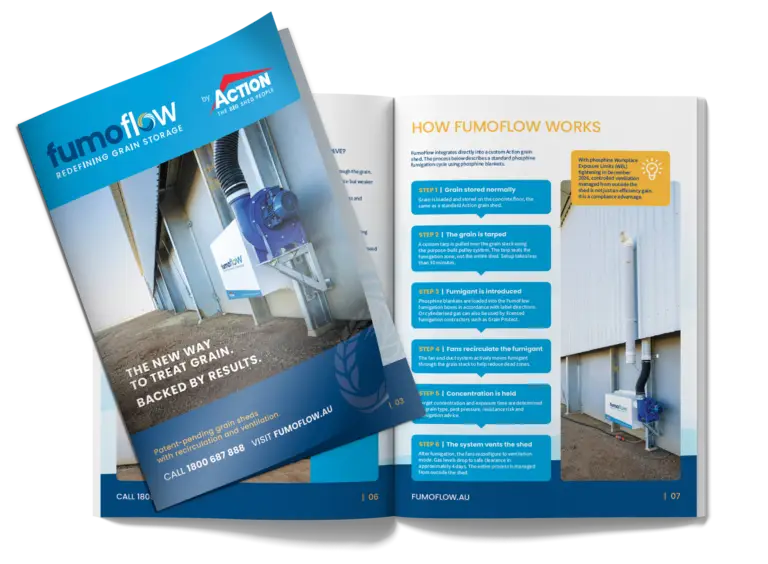
FumoFlow grain sheds were designed with tighter exposure limits in mind. Fumigant goes in and gas is vented from outside the shed, so there’s less need for anyone to be near the stack while treatment is under way.
The built-in recirculation and ventilation system controls how the shed is cleared once treatment is finished. In our full-scale trial on 5,420 tonnes of wheat, the shed reached safe clearance in 4 days using controlled ventilation.
New rules or not, FumoFlow is about making fumigation safer, easier and more effective for growers and contractors.
Talk to us
If you’re planning grain storage and want to know how FumoFlow could work on your property, talk to our team. Call 1800 68 78 88 or visit fumoflow.au.
This article is general information only and isn’t legal or safety advice. Check the current requirements with your state WHS regulator and always follow the product label.