Harvest is when storage plans stop being theory. Headers are running, trucks are queuing and grain needs a safe place to sit until it’s sold. How that grain will be fumigated is now part of the decision too. That’s why the question of sealed silos vs grain sheds comes up so often at this time of year.
The honest answer depends on your tonnage, the grain you store and how you like to run harvest. Each option has genuine strengths. This article compares sealed silos vs grain sheds vs FumoFlow side by side, using the table from our FumoFlow brochure, so you can weigh up what suits your operation.
What every fumigation needs to work
Whatever the storage, fumigation works on the same principle. The fumigant has to reach every part of the grain and stay at the right concentration for long enough. That is what controls insects at every life stage, including eggs and pupae. GRDC describes this as concentration multiplied by time, or C x T.
For phosphine, two thresholds are commonly referenced across the industry. Holding 200 ppm for 10 days is commonly cited for controlling susceptible insect populations, and 550 ppm for 7 days is commonly referenced for addressing most phosphine-resistant strains. The right target for your grain depends on your resistance history, the grain type and advice from your fumigation contractor.
If the gas leaks away, or never reaches part of the stack, insects in those areas survive and resistance builds. Our article on gas distribution in bulk grain fumigation explains why this matters so much in large storages. Sealed silos, standard grain sheds and FumoFlow sheds all aim for the same result, but they get there in quite different ways.
Sealed silos: the benchmark for holding gas
A gas-tight sealable silo is still the benchmark for passive fumigation, and for good reason. Because the silo itself holds the gas, phosphine released inside can build up and stay at concentration for the full exposure period. GRDC-backed research compared two silos that looked identical. The one that passed its pressure test held more than 300 ppm of phosphine in all areas for seven days. The one with slightly compromised seals could not do the same.
Sealed silos bring some real advantages:
- Proof of the seal: A sealed silo can be pressure tested before each fumigation, and GRDC recommends testing at least once a year. Few other storages give you that kind of certainty before the fumigant goes in.
- More treatment options: Gas-tight storage also allows controlled atmosphere treatments, such as carbon dioxide or nitrogen, as well as phosphine.
- Segregation: Separate silos make it easy to keep varieties, grades and seed apart, and to treat one batch without touching the rest.
- Cooling and recirculation: Sealed silos are usually fitted with aeration fans. In larger silos, a small fan is often used to recirculate phosphine for faster, more even distribution.
The trade-offs are mostly about scale and upkeep. Seals and pressure relief valves need regular maintenance to keep passing their test. On-farm silos generally top out at around 3,000 tonnes each, so storing a big harvest means several silos, augers and more handling at intake. Trucks can’t tip inside a silo, and a silo can’t double as machinery or fertiliser storage in the off-season. GRDC also notes that retro-sealing older silos is a significant cost, with varying success.
Standard grain sheds: great storage, harder to fumigate
A standard grain shed solves a different set of problems. It holds thousands of tonnes under one roof and trucks can tip inside at harvest. The cost per tonne is low at scale, and the shed can store machinery or fertiliser once the grain has gone.
Fumigation is where a standard shed is harder work. Sheds are built to keep the weather out, not to hold gas in, so there are gaps at the doors, eaves, ridge and cladding laps. To fumigate, growers either seal the whole building or tarp the grain stack. Both methods are passive. Once the fumigant is in, the gas is left to spread on its own. GRDC puts its movement through cereal grain at around 6 metres every 24 hours. In a large stack, that can leave pockets where the concentration falls short.
It is also hard to confirm the result. Tarped grain and sheds can’t be pressure tested the way a sealed silo can. Checking the concentration means probing with a gas meter in many places. Venting is usually passive too, relying on natural air movement to clear the gas.
FumoFlow grain sheds: active fumigation in a shed
FumoFlow sits between the two sides of the sealed silos vs grain sheds debate. It is a patent-pending recirculation and ventilation system built into a new Action grain shed at the design stage. The shed keeps the storage strengths above and adds a way to fumigate actively rather than passively.
Unlike a sealed silo, a FumoFlow shed’s exterior shell doesn’t rely on being gas-tight to work. Rather than leaving the gas to hold and spread on its own, the tarp contains the fumigation zone and the fans keep the fumigant moving through the stack for the full treatment.
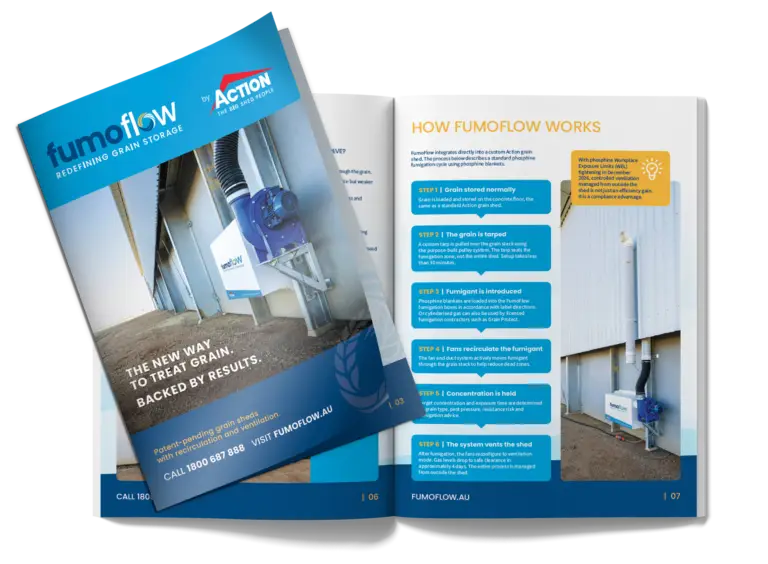
When grain needs treating, a purpose-built tarp is pulled over the stack on a pulley system, which takes under 30 minutes. Fumigant goes into fumigation boxes from outside the shed, either as phosphine blankets or as cylinderised gas applied by a licensed contractor. Fans and built-in ducting recirculate the fumigant through the grain until the required concentration is reached, then switch off while the grain is held for the exposure period. Once treatment is finished, the same fans switch to ventilation mode and clear the shed, all managed from outside. How FumoFlow Works walks through each step.
FumoFlow isn’t a retrofit, and it doesn’t turn a shed into a silo. It is a different way of reaching the same goal: the right concentration, right through the stack, for the full exposure period.
Sealed silos vs grain sheds vs FumoFlow at a glance
The table below is adapted from the comparison in the FumoFlow brochure. It includes non-sealed silos too, because they are still common on farm. GRDC is clear that repeated fumigation in storage that isn’t gas-tight gives poor results and selects for phosphine resistance, so non-sealed silos aren’t a fumigation option.
| Feature | Non-sealed silo | Sealed silo | Standard grain shed | FumoFlow grain shed |
| Active gas recirculation | No | In many larger silos | No | Yes |
| Even gas distribution, floor to surface | No | Yes, when gas-tight | Hard to achieve | Yes |
| Seal can be pressure tested | No | Yes | No | No, monitored with probes |
| Controlled ventilation from outside | No | Varies | No | Yes |
| Time to safe clearance | N/A | Varies | Several days+ | About 4 days (trial) |
| Trucks tip inside | No | No | Yes | Yes |
| Over 3,000 tonnes in one structure | No | No | Yes | Yes |
| Multi-purpose off-season asset | No | No | Yes | Yes |
| Low cost per tonne | Varies | Varies | Yes | Yes |
| Long-term storage | Yes | Yes | Limited | Yes |
| Fast intake at harvest | No | No | Yes | Yes |
Comparisons are generalised. Outcomes vary with storage design, sealing quality, fumigation practice and grain type. Talk to your fumigation contractor for advice specific to your operation.
Read across the rows and the sealed silos vs grain sheds picture becomes clearer. Sealed silos lead on proving the seal and on segregation. Standard sheds lead on volume, intake speed and flexibility. FumoFlow aims to combine shed-scale storage with active, even fumigation.
What the FumoFlow trial showed
In March 2026, Action Steel ran the first full-scale FumoFlow trial on 5,420 tonnes of wheat in a commercial grain shed. The fumigant was 18 x 1.7 kg Phostoxin phosphine blankets, at about 1.4 g/m³ and within the maximum label rate. Twelve independent probes at surface and floor level monitored the stack for 15 days.
The average peak across all 12 probes was 1,068 ppm, reached at 49 hours. Every probe exceeded 550 ppm within 49 hours and held above it for the full 7-day period. Every probe also stayed above 200 ppm for the full 10 days. The lowest reading recorded was 268 ppm, after 362 hours. Once ventilation started, the shed reached safe clearance in about 4 days.
It is one trial, in one shed, on one grain type, and results will vary with conditions. But it shows that active recirculation can hold commonly referenced concentration thresholds right through a stack of more than 5,000 tonnes.
Sealed silos vs grain sheds: which is best on your farm?
When weighing up sealed silos vs grain sheds, there’s no single right answer, and many growers run a mix of storage for good reason.
Sealed silos make sense when you want to segregate varieties or seed, fumigate smaller batches, hold grain long term with aeration cooling, or keep the option of controlled atmosphere treatments. If you already have a well-maintained bank of sealed silos, they remain one of the most reliable ways to fumigate.
A standard grain shed suits growers who need large, low-cost storage and fast intake at harvest. It works well if you rarely fumigate, or are comfortable tarping the stack with a contractor.
A FumoFlow grain shed is worth considering if you store large volumes of higher-value grain, such as milling wheat, malting barley or food-grade pulses, and expect to fumigate regularly. It keeps the scale and flexibility of a shed while giving you active, even fumigation managed from outside. The FumoFlow FAQs answer the questions growers ask most.
Plenty of operations end up with both: silos for segregation and seed, and a shed for bulk tonnage. In that case, sealed silos vs grain sheds isn’t a choice at all, just a question of which grain goes where.
A note on the new phosphine exposure limits
The new workplace exposure limits for phosphine cut the 8-hour average from 0.3 ppm to 0.05 ppm. Start dates now vary by state. Victoria and Western Australia have moved to 1 December 2029, New South Wales to 1 July 2028, and South Australia has also deferred. Safe Work Australia has more on the change, and our phosphine exposure limits update covers what it means on farm.
Whatever you decide on sealed silos vs grain sheds, venting is getting more attention. So is how close people need to be to fumigated grain. It is worth factoring into any new storage plan.
To talk through which storage setup suits your tonnage and grain, visit fumoflow.au or call the FumoFlow team on 1800 68 78 88.